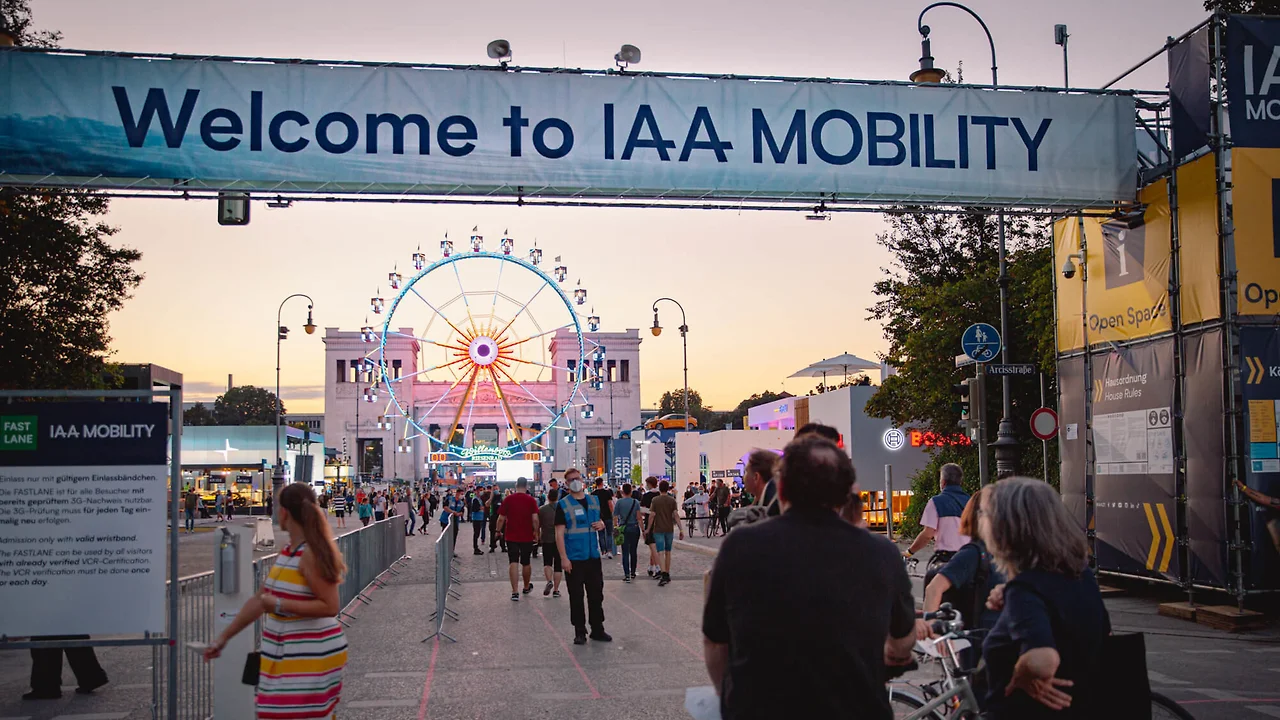
From ‘Cars’ to ‘Mobility’… On Site at Munich IAA Mobility 2021
Cover photo source=iaa.de
The ’transformation’ of the Frankfurt Motor Show… electric vehicles, bicycles, and other future means of transport gather, with startups at the center
“The Future of European Mobility Lies With Us.”
Every autumn, the event that symbolizes Munich, Germany is unquestionably Oktoberfest, the largest beer festival. But due to COVID-19, Oktoberfest could not be held for the past two years, and during the long lockdown period the festival city of Munich had a somewhat subdued atmosphere. This week, after a long while, an “event” began that breathed life back into the whole city and drew the attention of the related industries. From September 7 to 12, Munich IAA Mobility 2021 is taking place.
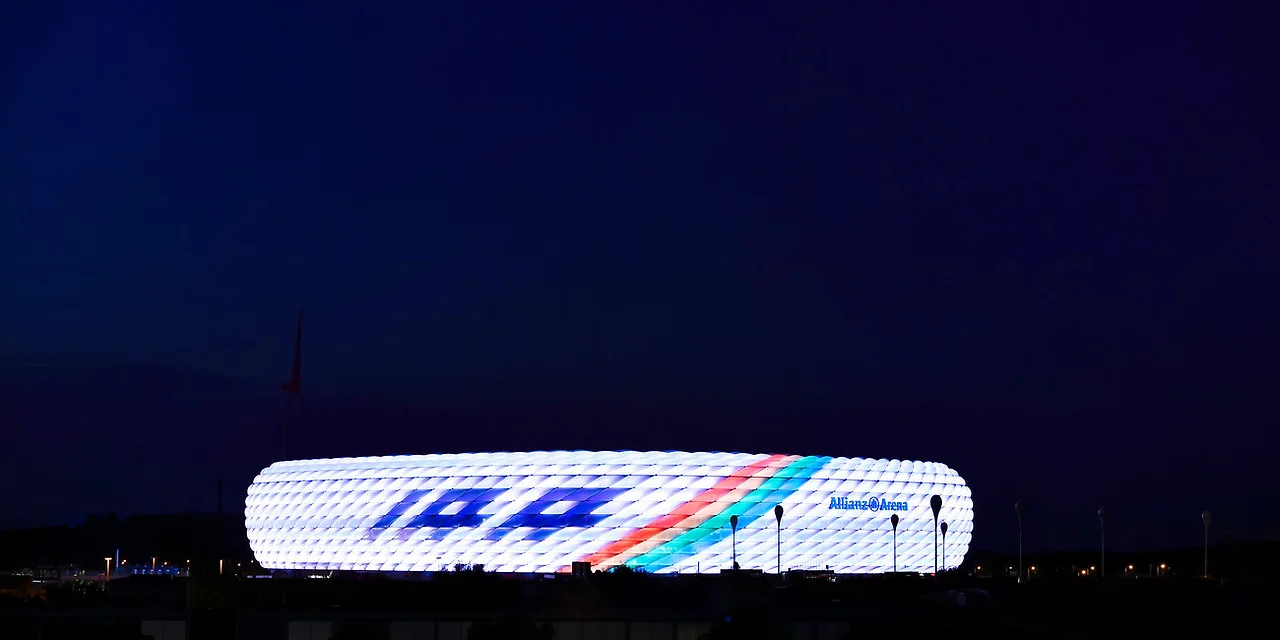
The Allianz Arena, Munich’s FC Bayern stadium, brightly lit to welcome the ‘IAA Mobility’ event. Photo=iaa.de
IAA (Internationale Automobil Ausstellung) is an event long known to us as the “Frankfurt Motor Show.” The world’s largest automobile fair, it began in 1897 and boasts a long history and tradition. Until now, in even-numbered years a commercial-vehicle fair for trucks and the like was held in Hanover, and in odd-numbered years a passenger-car fair was held in Frankfurt.
In 2015, about 930,000 visitors came to the IAA. It was during that very period that the Volkswagen diesel scandal shook the world. As trust in the auto industry collapsed and public opinion about the climate crisis spread, fundamental doubts and critical views of the automobile industry began to emerge openly. In 2017, 810,000 people visited the Frankfurt Motor Show, and in 2019, 560,000. While the number of visitors plummeted, the number of environmental protestors surged, and the Frankfurt Motor Show, too, needed change.
From Cars to Mobility: The Transformation of the IAA
No matter how old a tradition is, without innovation it is bound to fade into the pages of history in the end. The German Association of the Automotive Industry (VDA), which hosts the IAA, judged that the Frankfurt Motor Show needed innovation and searched for another city that could turn the event into a real “happening.” After a contest with Berlin and Hamburg, Munich was finally selected as the host city of the IAA.
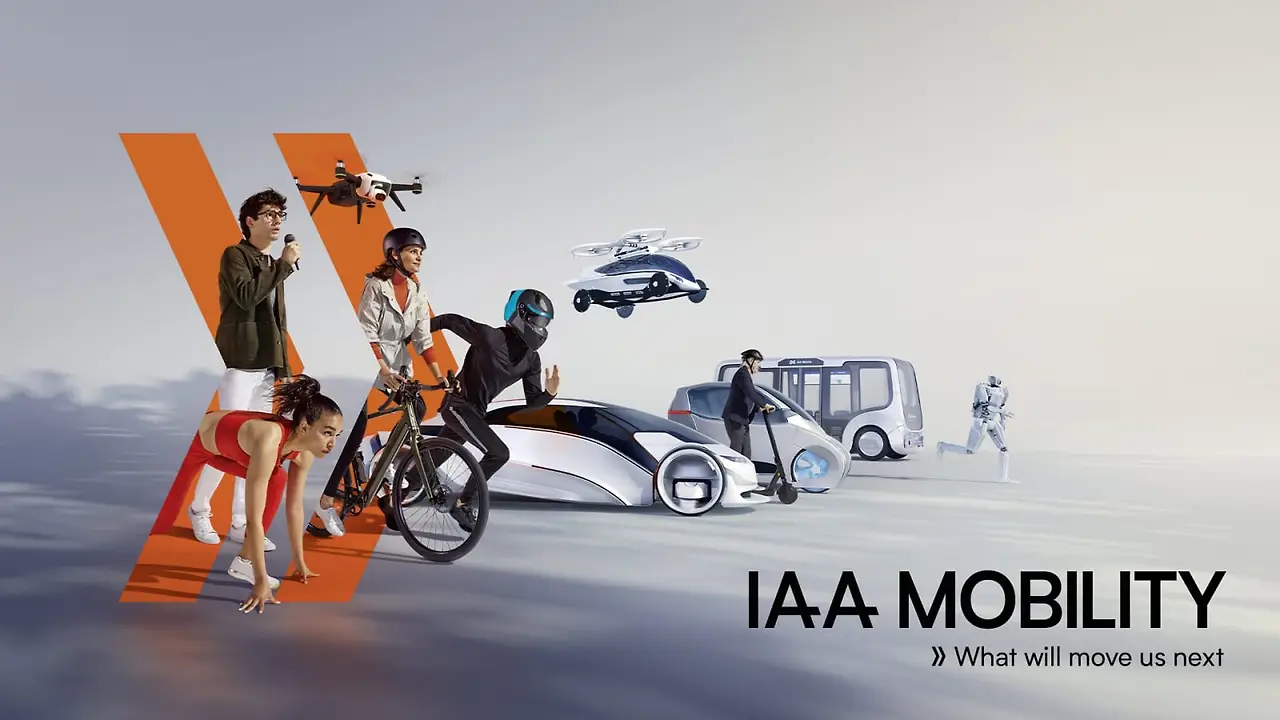
“What moves us now?” At IAA Mobility, you can see not only cars but every means for future mobility. Photo=iaa.de
Ahead of the first event in Munich in 2021, the government and the industry held long discussions on how to hold the event successfully. Although whether it could be held at all was uncertain because of COVID, that was a measure of how important the automobile industry’s standing is in Germany.
Last May, as the COVID situation gradually improved, it was decided to hold the exhibition in a hybrid format that could be enjoyed both online and offline at the same time while observing hygiene rules — along with a new name, IAA Mobility. The aim was to shed the image of an exhibition centered on “internal-combustion-engine cars” and on famous automakers’ new-car unveilings, and to change the event’s name itself in order to clearly take the direction of an exhibition for future mobility. Under the motto “What will move us next,” the exhibition set up sections throughout the city of Munich where one could experience advanced transportation systems, so that ordinary citizens could experience various forms of future mobility.
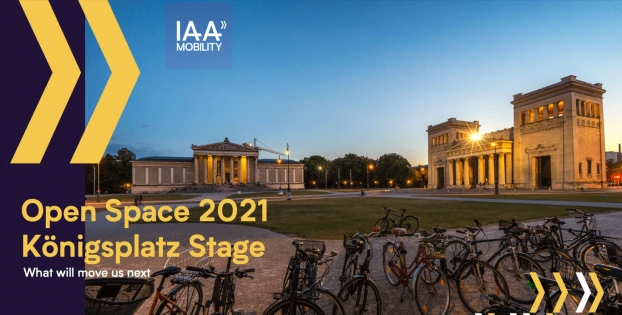
During IAA Mobility, you can tour Munich’s major attractions using electric cars, sharing cars, electric bikes, driverless cars, and more. Photo=iaa.de
As the word “mobility” implies, a notable feature was the large number of booths for things other than cars. Booths related to mobility services such as bike-sharing platforms, car-sharing, and car subscriptions stood out in particular. As many as 75 bicycle-related companies took part in the exhibition, and there were even two separate small halls for bicycles. It was an unusual scene not seen at conventional motor shows. Apart from the cars some parts suppliers installed to aid understanding, internal-combustion-engine cars were hard to find — enough that one could fairly call it an EV exhibition.
That was only natural: last July, the European Union announced a policy that effectively bans the sale of new internal-combustion-engine cars running on gasoline, diesel, and the like by 2035. The management consulting firm McKinsey announced that electric vehicles will account for about 75% of the European market in 2030. That is on the order of 70 million vehicles. In Europe, electric vehicles are becoming the most mainstream cars. With the exit of internal-combustion cars, various alternative means of transport are gaining the spotlight, shifting from the age of the “car” to the age of “mobility.”
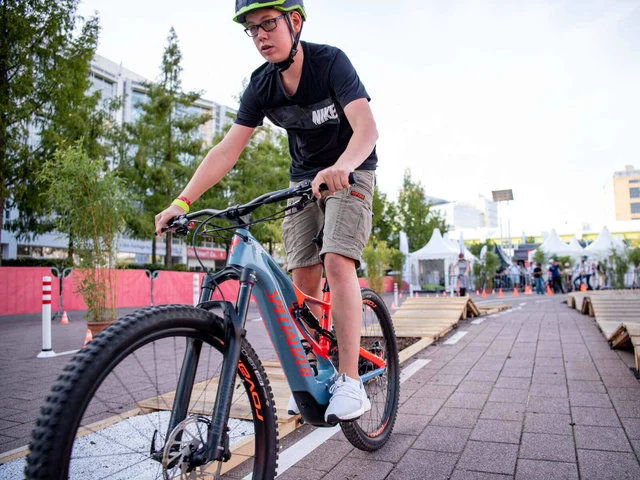
A test-ride area for new bicycle models set up in the outdoor space of the IAA Mobility venue. Photo=iaa.de
Because of this, bicycle-related companies received the full spotlight of Germany’s major media. The big trend in particular is cargo electric bikes. Berlin startup Sblocs presented a cargo electric bike at IAA Mobility. It shows the quality of a compact car when it comes to carrying and transporting cargo, yet its price is far cheaper. The Dutch shared cargo-bike platform Dockr also took part in IAA Mobility and announced its entry into the German market.
Startups Leading Future Mobility Gather Together
It is startups that have emerged as the hot players of IAA Mobility. IAA Mobility predicted that startups will play an important role in the future mobility industry. The view that startups — which throw out, execute, and realize innovative ideas hard to produce from established industries — are the core of the mobility industry was reflected from the very process of organizing the fair.
Rather than feeling like a token presence in a venue centered on famous large corporations and global automakers, a Startup Area was placed at the most important spot in each venue. It was organized so that visitors could naturally encounter the businesses of the startups leading the future. It is a large-scale affair, with 76 startups from around the world participating in a space of three halls totaling 1,500 m².
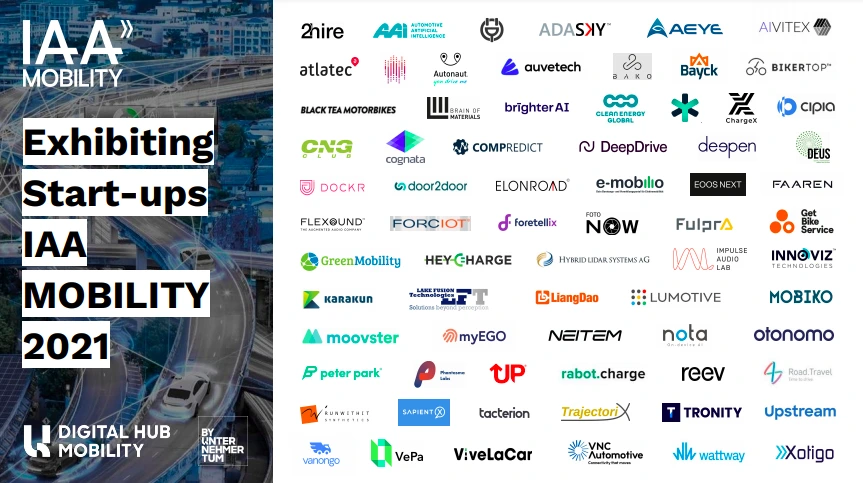
Various mobility-related startups taking part in the IAA. Korean startup Nota also stands out. Photo=Digital Hub Mobility
Here, startups with solutions in autonomous driving, driver assistance systems, lidar, camera systems, AI, alternative mobility beyond cars, sound/audio systems, electric bikes and cargo bikes, EV charging infrastructure, battery technology and automotive materials, and smart city solutions took part. Among the Korean startups, Seoul Robotics participated together with the U.S. lidar leader Velodyne, and Nota, which provides on-device AI solutions, made its presence felt with a standalone booth.
There are also a variety of events for startups. On the evening of September 7, the startup pitching program “#NextLevel IAA MOBILITY Startup Challenge 2021,” hosted by the global consulting firm PwC, takes place. Startups had been applying for this event since August. They receive professional coaching from PwC and take part in incubation to expand their own ideas and business models. Naturally, they network with key industry players in the mobility sector and gain the opportunity to bring their solutions to market.
The startup-field themes that PwC presented as worthy of the spotlight in future mobility are sustainability/climate change, future fuels, smart city/urban mobility, mobility safety, autonomous driving, e-sports/gaming, Mobility as a Service (MaaS), industrial solutions, connectivity, rural mobility, cybersecurity, electrification, AI, last mile, design, and post-COVID mobility. These can be seen not only as the most important themes in the future mobility industry but also as the themes most in demand in existing industries. It also means that startups providing focused solutions on these themes are well worth challenging the global stage.
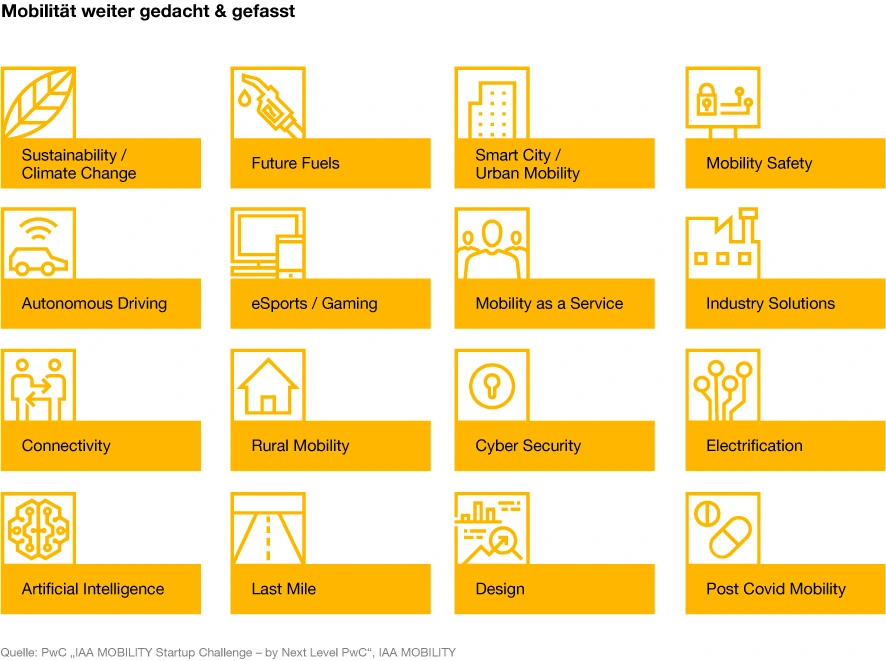
The call-for-entries themes of PwC’s ‘Next Level Startup Challenge.’ You can see what the important themes in future mobility are. Photo=PwC.de
Bits & Pretzels, the startup conference held at Munich’s Oktoberfest in late September, also naturally moved into IAA Mobility as Oktoberfest was canceled. On September 9, the “Founders Day” event hosted by Bits & Pretzels takes place — an exclusive event where, in addition to forming startup networks within Bits & Pretzels, one can hold table meetings with investors, VCs (venture capital), and angel investors. In addition, Dassault Systèmes, the French 3D-related software company selected as a Fortune 50 company, supports startups by setting up a meeting lounge just for them. Next week, we plan to meet in person the European startups that took part in the IAA Mobility exhibition, introduce their innovative ideas, and forecast the future of the mobility sector.
Eunseo Yi
eunseo.yi@123factory.de
This article is an edited and adapted version of [European Startup Chronicles] from <Bizhankook>.