
The Dawn Hours Essential for Survival
Only around 10 p.m., while putting the children to bed, I always fall asleep right along with them. At 2 a.m., thinking of all the work piled up, my eyes snap open.
Everything around me is silent. My day begins. Sitting with only a small lamp lit on the dining table, focused on my laptop screen, is the one time of day that is entirely my own. Whether I do something useful or something useless, something I want to do or something I must do, that time of quietly doing my own work is the source of strength that sustains the rest of my daily life. If I am too tired and skip it, an inexplicable irritation sits clumped in a corner of my mind all day long. That is why the hours between 2 and 4 a.m. are precious to me. After putting the children to bed, I opened my laptop on the dining table. The lights downstairs were on, too.
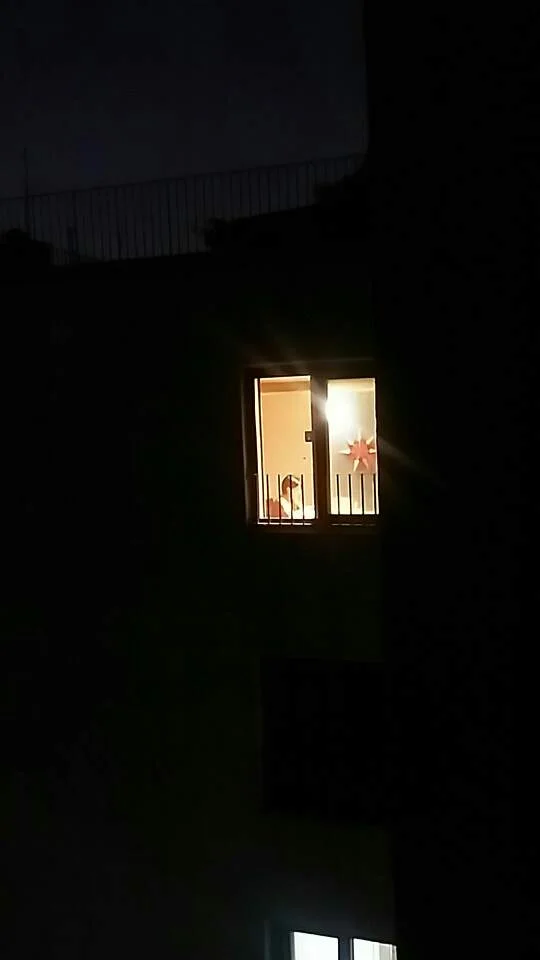
Dawn is my official working hours.
The Woman Downstairs
I came to learn that at the same hour, the woman downstairs was also awake, doing something. In the same spot where I moved my hands busily over a laptop keyboard, she was holding a brush, diligently filling a canvas. The woman downstairs is a painter. The woman downstairs has one child. After we discovered each other’s existence between 2 and 4 a.m., we grew close very quickly. She told me I was someone bright like the sun, and I very much liked how her humor was cool and mellow like moonlight.
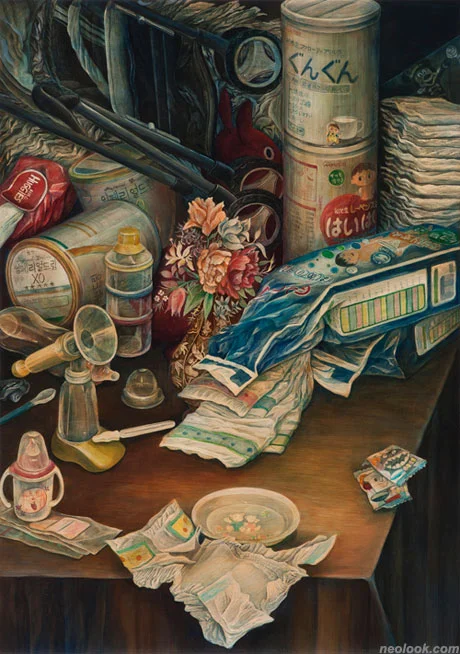
Yukako Kondo, Necessities. Acrylic on cotton on panel_72.5 X 51.5 cm_2010
It was through her paintings that I learned she, too, wakes at a similar hour to paint. The color of darkness that dominates her paintings seems to say, ‘deep night, alone, immersed, in order to live.’ A solitary darkness drips from her pictures.
She and I met as neighbors in a village where artists live together. Because people from various artistic fields live side by side, we take interest in each other’s work and talk about it often. We frequently ask each other, in passing, what we are working on these days. But when we first met, what we talked about was almost entirely childcare and the children’s school matters. I think we both smiled faintly at the content of our own conversation.
Right — you and I, before being independent creators and artists, we are mothers. Our husbands probably wouldn’t talk about this if they met. They would bring up their work. Men who seem absorbed in the grand questions of this world. But we talked about a child being sick and unable to go to school. About how the mother, too, could do almost nothing for a week because she had to nurse the sick child, and about how long it takes, once daily life returns, to get back to one’s work. That the only time to work alone with peace of mind is after putting the child to sleep. I remembered what someone once said: mothers never waste time.
Conversation
Yukako Kondo, the woman downstairs, was born in Osaka in 1973. People from Osaka are famous for being humorous. Perhaps because Yukako has that temperament too, conversations with her are always a pleasure. Yukako sometimes says she feels as if she carries a ‘mission to be funny,’ but thanks to that mission, my daily life feels rescued. Above all, as befits an artist, her way of seeing the world can be unique. When she plays with the children, that humor and creativity are on full display. The pictures Yukako paints with her son Jimu, and the picture books they make together, are the greatest art lessons that only a painter mother can give.
While helping prepare the contents of the pamphlet for Yukako’s solo exhibition in Munich, I was able, for the first time, to have a long, serious conversation about Yukako’s paintings and her work.
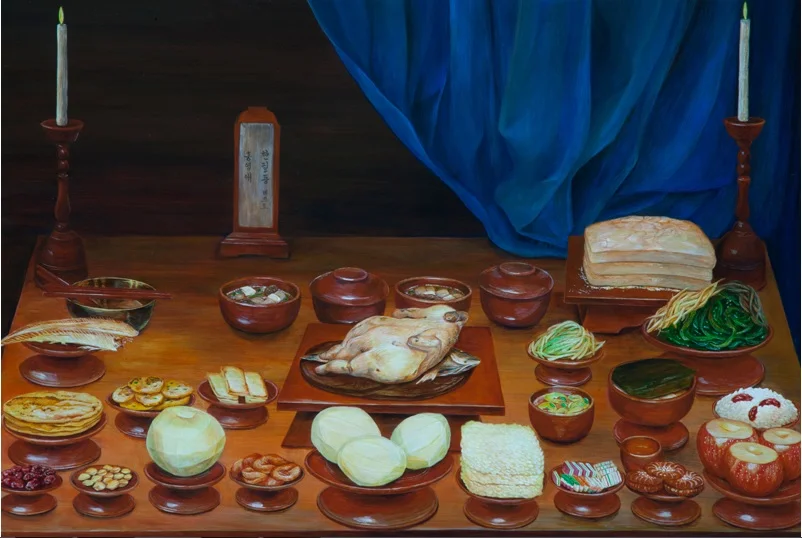
Yukako Kondo, Ancestral Rite Table of the Han Family, acrylic on cotton on panel, 51.5 X 72.5 cm, 2012
There seems to be a special technique unique to Yukako Kondo in your work.
Since 2005, I have painted everyday household items and food while quoting the concept and imagery of vanitas* (transience), the theme of 17th-century Dutch still-life painting. Looking at the still lifes seen in 17th-century painting and the still lifes seen in modern life from my position as someone living in the 21st century, I have reflected on the presence of life and death, which grow ever lighter in contemporary society.
*Vanitas still life: a genre of still-life painting from the 17th-century Netherlands and Flanders that expresses the futility of worldly and material things.
Many of the subjects in your paintings resonate with me as a woman. How do you choose your subjects and methods?
In 2007 I married a Korean man, and afterwards, through my in-laws, the ancestral rites, and the presence of my parents-in-law, I naturally had more and more occasions to encounter traditional Korean culture.
The first minhwa (Korean folk painting) series began casually, while I was thinking of a painting to give as a wedding gift for my husband’s older brother.
By painting the imagery of vanitas still life together with peaches (symbolizing eternal youth) and watermelons (symbolizing fertility) taken from minhwa, I conveyed feelings of celebration and of wishes, while carrying transience at the base.
Afterwards, I became thoroughly absorbed in the fun of it — the humor that minhwa carries, and the varied meanings of each and every object used in minhwa.
Considering vanitas still life and minhwa at the same time, I discovered another interesting point: vanitas still life speaks about death, while the munbangdo (scholar’s study painting) of minhwa speaks about life. I found it so fascinating that this contrasting perspective exists between West and East, so I blended the imagery of vanitas still life with the munbangdo imagery of minhwa.
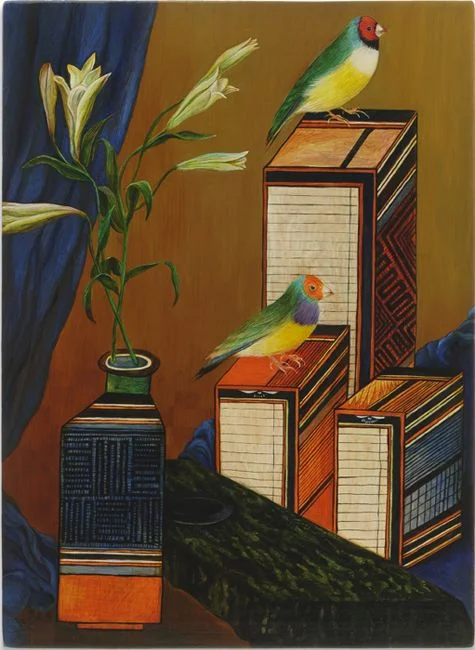
Yukako Kondo, Theo and Thea Thea, acrylic on cotton on panel, 33.5 X 24.5 cm, 2011
I was curious how still lifes with different painting styles and different meanings would come together on a single table (this ’table’ is the artist’s dining table and desk, and indeed the stage of life).
Vanitas still life, which faces death, carries a moral and didactic message for a better life, and munbangdo, which faces life, also carries hopes for the future — so in the end, both are looking at life.
In that way, my work, which began by looking at transience, has been developing into work on another level through my life in Korea and, recently, in Germany. That is, while keeping a realistic transience at its base, the still-life objects of our fleeting, repetitive daily lives tell us of the weight and beauty of their very existence, and offer us the consolation of life.
The colors in your paintings are extremely captivating. How is that darkness made?
At university I learned oil painting techniques, even making oil paints myself from pigments; I cut wooden panels myself, covered and fixed cotton cloth over them, then mixed calcium carbonate powder with animal glue to make gesso, applied it to the canvas, and worked. It felt less like merely learning material techniques than like experiencing the working pace and environment of the Middle Ages. What captivated me was that a work is completed by building up over a long time, that only the essence of the material is condensed and treated with care, and above all, the depth of those colors.
To explain simply, it is a technique in which you render the bright parts of your subject in white and keep layering transparent color on top. Whenever brightness is needed in between, you render it in white again and layer transparent color over it. Originally it is a technique using oil and tempera, but now I work with acrylics, adapting and developing it.
I think that technique of layering, and layering again, resembles my work — which expresses a daily life that accumulates day by day — and my life itself.
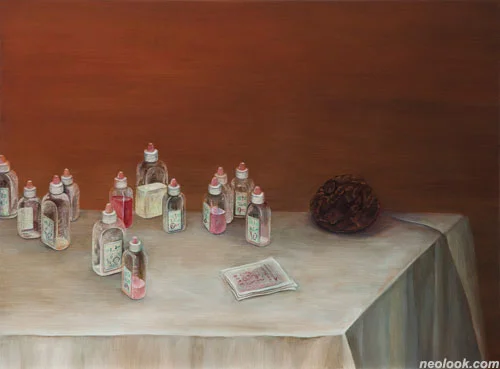
Yukako Kondo, Still Life with Pet Bottles, acrylic on cotton on panel, 39 X 54.5 cm, 2010
At Night, Mothers Make History.
Many mothers finally have time of their own only after putting their children to bed. In my case, falling asleep together while putting the child to bed is an everyday affair, so securing that time is a constant war against sleep. Why must every day be fought like a war……
When I visit Yukako’s home, I can witness the traces of that fierce war all the more clearly. In a corner of the kitchen sit the bread and cups she used as objets, and the brushes and paints that must have moved diligently through the night. The tools of housekeeping and the tools of painting coexisting in the kitchen somehow look like valiant weapons. This is how we confirm each other’s nights, wink at each other, and share a comradeship only we can understand.
My comrade, Yukako downstairs.
Eunseo Yi
eunseo.yi@123factory.de