
Who do we call a scientist? When many children once dreamed of becoming scientists, they probably pictured people holding beakers in laboratories, looking through microscopes, or wrestling with theories in physics and chemistry to make discoveries.
What is the reality? Above all, science has an immense effect on the lives we lead. It is a field that advances through continual innovation in the field, and scientists and engineers devote themselves to R&D and technological innovation in science, engineering, and related interdisciplinary fields.
Academic achievements can define a scientist, but many innovators working at the frontier of innovation directly connected to everyday life can also be called scientists in a new sense. Engineer Changhyuk Bae, one of the innovators I met while seeking Korean scientists in Germany, is close to such a scientist concerned with innovation. He works as a software and systems engineer at MBition GmbH, the Mercedes-Benz Innovation Lab in Berlin.
MBition is a Mercedes-Benz subsidiary founded in 2017 with the motto “Mercedes-Benz’s software factory.” Located in Berlin, it employs about 250 engineers from 42 countries. Its principal work is designing and implementing infotainment systems for Mercedes-Benz vehicles.
Working closely with Mercedes-Benz’s plant in Sindelfingen in southern Germany, MBition’s mission is to develop future software. It focuses on three areas: embedded systems that develop and integrate in-vehicle infotainment software; cloud services that exchange information for infotainment; and mobile apps that deliver personalized experiences.
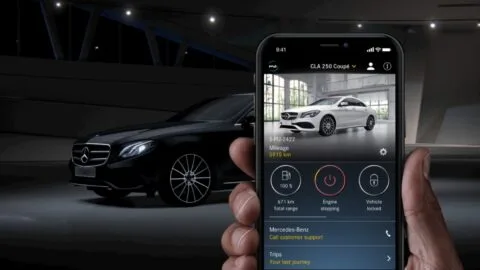
mercedes me 2020 app ©️ Mercedes Benz
For example, the Mercedes Me 2020 app, developed the previous year, lets users control their car from a smartphone. It provides the vehicle’s current status, the next inspection date, pre-entry air-conditioning control, and suggestions for the best route to charging stations for electric vehicles.
MBition developed its own operating system, MBiENT. It makes it possible to develop vehicle-specific infotainment systems independently of the automotive production cycle. In other words, new applications can be run and tested before they are implemented in the hardware installed in a vehicle. The platform makes continuous reuse of infotainment systems possible.
It also develops ADAS (Advanced Driver Assistance Systems) for autonomous driving, with work spanning the entire process from algorithms to platforms and from simulation to validation.
Establishing software and AI companies to develop in-house platforms for innovation is a worldwide automotive-industry trend, not something limited to Mercedes-Benz. It is a natural step toward future vehicles such as EVs and self-driving cars.
The Road Led by Open Source
Before joining MBition, Bae worked as a software developer at LG Electronics for about nine years. He developed software for particular devices, including everyday consumer electronics such as TVs and mobile phones. After LG acquired webOS from HP in 2013, he mainly handled software integration.
Integrating things made by others was his main responsibility. That meant there was much to know and study beyond his own specialty. Fortunately, LG Electronics guaranteed substantial autonomy in research and learning. Unlike the usual image of large-corporate culture, it was quite flexible about work and gave employees many opportunities to learn and innovate through overseas conferences and similar events.
Through those opportunities, Bae was able to gain the latest information in his field and network more easily with experts around the world. These experiences gradually strengthened his dream of working abroad.
In Korea, developers commonly become managers after reaching a certain level of experience and age. Most people therefore work with management as their goal, and there is an atmosphere in which older people must step away from hands-on research and development.
But among engineers from many countries whom he met at conferences, Bae saw people still working as developers in their sixties and continually contributing to innovation. It showed him a different picture of the future from the one he had previously known.
He also continued to develop himself through open-source software and set a direction for the path ahead. That compass enabled him to keep pursuing side projects while working at LG.
He has participated in Open Source Frontier (KOSSLAB), the OpenEmbedded Technical Steering Committee, and the Yocto Project Advisory Board, continuing to learn through communication and feedback with other developers.
Bae explained that open-source software provided motivation of a different kind from company work because it is based on peer review and community-driven production.
He also translated books while working on the Yocto Project, publishing Embedded Linux Development Using the Yocto Project (2014), Yocto Project Using BeagleBone Black (2015), and Embedded Linux Projects Using Yocto Project Cookbook (2016). More than those achievements, he says, the feeling of growing together by sharing knowledge with others was especially meaningful.
He is currently translating Automotive Software Architect, and he has already chosen the next book to translate after that. His plan to share knowledge while studying continues without end.

Engineer Changhyuk Bae of the Mercedes-Benz Innovation Lab © Changhyuk Bae
Taking on Automotive Challenges with a Long-Term Perspective
The same projects also enabled Bae, who had worked in consumer electronics, to move into the automotive field.
The GENIVI and AGL (Automotive Grade Linux) projects Bae experienced were for automotive software development. They used a Yocto-based development environment and Linux as the OS. While participating in developer training for open source in Korea through these projects, he also developed a strong interest in automotive technology. That interest became the driving force that brought him to MBition.
He described the project as a valuable opportunity for growth: although its goal was developer training, the process of studying more in order to share knowledge and explain it clearly to others helped him grow. It also became an experience that naturally led him to a new challenge in the automotive field.
Unlike consumer electronics, the automotive industry moves on a very long cycle. Because it is directly connected to safety and human life, it is cautious about introducing new things. Future cars such as EVs and autonomous vehicles are attracting attention, but the industry structure makes it difficult to change everything at once.
To change gradually, enough time must be secured, and research must take a long-term view to produce the most stable results possible. Companies must also spare no support in recruiting the world’s best talent.
MBition’s developers are IT specialists, but not all are automotive specialists, so the company invests heavily in employee education in this area.
It provides professional education so employees can learn automotive-development processes. Bae says he has benefited greatly from these programs. Recently he became interested in autonomous driving and enrolled in an online course on the subject, building the foundation to develop with the automotive industry’s larger picture in mind.
Bae explained that when he was in Korea, he studied areas of interest and met people through overseas conferences, but now that he works at the center of a field he cares about, every day feels like a conference. He added that it is enjoyable to gain information unavailable from outside and to advance technology through discussion and collaboration with colleagues.
The culture of collaboration was not unfamiliar, but he said he had not yet reached a conclusion about the unusual degree of autonomy exercised by colleagues at work. He sometimes wondered whether products could be delivered well because teams were granted such extensive autonomy.
Germany is well known for work-life balance, so he expected some of this. Still, when a manager asks people to work late because a product has an urgent problem, colleagues calmly state that German law makes working more than ten hours a day illegal and say they will not do it. Seeing managers accept that feedback without fuss made him think that working there requires a different way of navigating professional life from Korea.
In Germany, except for managers, it is normal to have almost no late-night or overtime work, and people sometimes take about a month of summer vacation. Because this does not exceed the contracted vacation allowance, no one pressures them or raises an issue. Bae said this initially felt unfamiliar, and he wondered how a month-long absence would be covered.
A New Path Unfolding Through Openness, Participation, and Sharing
Bae now stands before a new path of learning and challenge. He applied to MBition’s first exchange program with Daimler affiliates worldwide and gained an opportunity to work at Daimler Korea. He would choose an R&D project at a Daimler affiliate and work with it for a month while learning something new.
He said he would be assigned to a team responsible for Daimler R&D in Korea and use the month as an opportunity to study and share. While at MBition, his goal is to use and experience as many programs run by Daimler headquarters as possible.
Having worked at one company for a long time, Bae has nevertheless accumulated more references than others through continuous training and experience in new fields. In the interview, he shared his ambitions for what he hopes to achieve in the next ten years.
He said, “Many people dream of Silicon Valley. I did too. But through the experience of working at Mercedes-Benz, I learned that what I do is more important than where I am or which company I work for. I believe that if I do well in my field, the company I have dreamed of will knock on my door first.”
He concluded the interview by saying that, among engineers, he wants to pursue the concrete goal of becoming an architect who designs entire systems.
This article was contributed to [Korean Scientists in Germany] of
Eunseo Yi
eunseo.yi@123factory.de