Germany has a wide range of basic and applied science research institutes. Among them, the Fraunhofer-Gesellschaft comprises 74 institutes across Germany and, with some 28,000 employees, is Europe’s largest applied technology research and development organization.
It was first founded in Munich, Germany in 1949, named after the German physicist Joseph von Fraunhofer, who opened a new chapter in precision scientific instruments.
At its founding it started with 103 employees through the cooperation of the states of Bavaria, Hesse, and Württemberg, and in 1952 the German Federal Ministry of Economics designated the Fraunhofer-Gesellschaft — together with the German Research Foundation (DFG, Deutsche Forschungsgemeinschaft) and the Max Planck Society (Max-Planck-Gesellschaft) — as one of the three major non-university institutions for German research, making it one of the most important research institutes in German applied science.

Its total annual research budget reaches 2.8 billion euros (about 3.9 trillion won), and while it is a government-funded institute whose basic research funding is provided by the German federal and state governments, more than 70% of its research funds are raised through contract research for private companies and government projects.
In other words, compared with other public research institutes, the share of basic financial support from the government is low, so a major characteristic is that most research costs must be covered by its own income, such as contract research fees and service fees from industry or public research clients.
The fact that it has a financial model so distinctive that it is called the Fraunhofer model gives a sense of the institute’s character.
Put differently, Fraunhofer aims to develop technologies that can be put to practical use in every kind of industrial field and to commercialize them, so it can be considered the research institute furthest ahead in terms of innovation.
In particular, it takes on contract research for small and medium-sized companies that do not have their own R&D departments, developing and optimizing specific technologies and processes, and providing services from prototype production to small-batch manufacturing during product development, which makes it an important partner for companies.
The Fraunhofer-Gesellschaft currently holds more than 6,800 patents; in 2019 alone, 733 inventions were registered, and 623 patent applications were filed among them. That means an average of two patents are filed every day. This is an unrivaled level not only in Germany but in Europe.
The most successful patented products developed at Fraunhofer are in the field of audio and video coding technology. ‘MP3,’ the audio compression technology developed in 1992 by the Fraunhofer Institute for Integrated Circuits (Fraunhofer-Institut für Integrierte Schaltungen, IIS), earned an average of 100 million euros (about 125 billion won) in royalties every year until its licensing rights expired in April 2017.
In addition, core technologies such as real-time video playback (streaming video) and video compression (AAC video coding) were developed at the Fraunhofer Heinrich Hertz Institute (Fraunhofer Heinrich-Hertz Institut, HHI) in Berlin.
I met Dr. Jeonghwan Choi, group leader of the IC Design group at Fraunhofer HHI, to hear an introduction to Fraunhofer HHI and about his life as a scientist working as a tenured researcher at Germany’s finest research institute.
Valuable Experience at Samsung
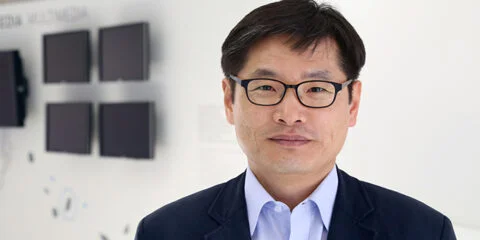
Dr. Jeonghwan Choi of the Fraunhofer HHI Institute in Berlin ©️Fraunhofer HHI
Dr. Jeonghwan Choi first began working at Fraunhofer HHI in 2011. In Korea, while pursuing his master’s degree, he took part in a project at the Samsung Advanced Institute of Technology, gaining a valuable opportunity to combine academic study and practical work in semiconductor-related fields. Thanks to that, he learned a great deal at the world’s best semiconductor development facilities, and after finishing his master’s he also received the opportunity to keep working at Samsung.
But thinking that if he started working right away he might last ten years at most, he pondered his future from a long-term perspective.
Just then, through a junior colleague who had returned from an internship at Infineon in Munich, Germany, he learned that ‘Germany charges no tuition fees.’ To study in Germany, he emailed 28 professors in related fields, introducing his research area and expressing his intention to pursue a doctorate. With little time to prepare he did not expect much, but precisely because his situation was desperate he contacted many professors — and to his surprise received offers from three universities.
Among them, he decided to enroll at the Institute for High-Frequency Engineering in the Department of Electrical and Computer Engineering at the Technical University of Munich (Technische Universität München, Fakultät für Elektrotechnik und Informationstechnik, Lehrstuhl für Hochfrequenztechnik, TUM HFT) and began his doctorate.
He started his PhD without knowing any German, but his advisor, who accepted him, is said to have greatly welcomed his enrollment. At the time, the Samsung Advanced Institute of Technology was conducting research looking five to ten years into the future, so it was considerably ahead in the semiconductor field. Seeing the contents of Dr. Choi’s master’s project, his advisor reportedly marveled, ‘You are the first person I’ve seen who learned and experienced so much during a master’s program.’
Dr. Choi then smoothly completed his doctorate with a dissertation on ’electronic circuits for optical communication’ and returned to Samsung, working at the Samsung Electronics research lab until 2011.
While working at Samsung, he had to monitor technologies worldwide even outside his own field. Because he had to do not only research but also planning in technology fields, studying new science and technology was essential. Every week his job was to summarize the material on a single A4 page, present it, exchange opinions, and debate — so if you did not study new technologies, you inevitably fell behind. That method from those days remains Dr. Choi’s way of studying to keep innovating himself to this day.
Life at Fraunhofer HHI, Where R&B&D Capabilities Must All Be Exercised
As Dr. Choi kept studying new fields, he turned his eyes to the international stage. At the time he was deeply interested in nanotechnology, and for that he scouted various regions including the American East Coast. In the end, the last project he had done at Samsung matched perfectly with Fraunhofer HHI in Berlin, and just seven hours after sending his résumé he received final acceptance from Fraunhofer HHI. Everything proceeded at full speed.
Fraunhofer HHI is a research institute boasting the world’s best technology in mobile broadband communications, optical network technology, and multimedia; in video coding in particular, it leads international standardization efforts such as MPEG, ITU-T VCEG, DVB, and IETF. You can therefore assume that most companies using video codecs in mobile devices today pay licensing fees to Fraunhofer HHI. Companies like Samsung, LG, and Xiaomi are among its biggest customers.
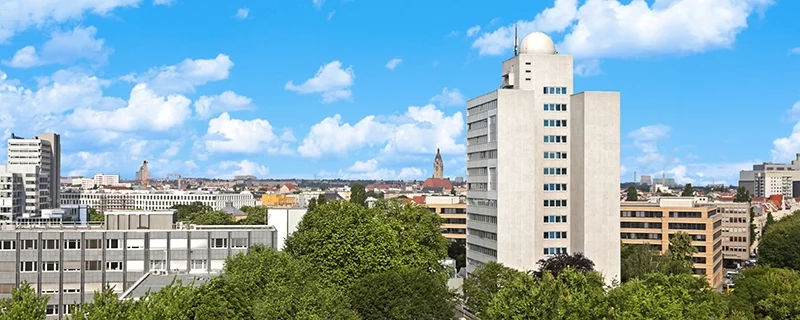
The Fraunhofer HHI Institute in Berlin — from the rooftop with its round dome, you can take in a panoramic view of Berlin. ©️Fraunhofer HHI
Dr. Choi says his experience at a corporate research lab has been a great help in his work at Fraunhofer HHI as well. Although Fraunhofer is a government-funded institute, a researcher’s capabilities needed to be exercised not only in research and development but also in the business domain of winning contract research.
In other words, many tasks usually considered secondary outside of research were essential duties at Fraunhofer. Beyond writing proposals and attending conferences, he had to meet with representatives of global companies such as Intel, Qualcomm, and Samsung through participation in technology trade fairs, and conduct business meetings at academic conferences as well.
And internally at Fraunhofer, he also had to identify the needs of companies, universities, and research institutes through analysis of website access statistics and conduct sales based on technology demand.
On top of that, as a public research institute, training master’s and doctoral students is one of its important roles. In this way, life at Fraunhofer is as intense as at any company. For that reason, researchers who do not fit well with this Fraunhofer style not infrequently change jobs midway, he says.
But Dr. Choi said, “There is more to learn from this busily spinning Fraunhofer life.” Some people vaguely assume that researchers at German public institutes work comfortably, keeping their ‘work-life balance,’ but he says that when you look at the researchers who excel here at Fraunhofer, you meet many people completely immersed in ‘work = life.’
Dr. Choi explained, “This differs in nature from night shifts and overtime in Korea. It is not done because someone orders it, nor out of succumbing to pressure, but because of a kind of professional ‘sense of calling’ as a researcher.” He added, “They study constantly, immerse themselves joyfully in their fields, and are sincere in their activities for research,” and said that over his ten years at Fraunhofer he, too, could not help but naturally acquire that sense of calling — showing me his thick stacks of study materials.
Learning Through Encounters
Dr. Choi has long been active in the Korean Scientists and Engineers Association in Germany (VeKNI). Founded in 1973, VeKNI is the oldest Korean scientists’ and engineers’ association in Europe; its technical divisions are finely subdivided, and networking among scientists in each specialized field is lively.
Emphasizing the importance of networking among Korean scientists, Dr. Choi explained that VeKNI is fulfilling this role admirably. He also said, “In every technology, Asia — including Korea — is leading the way,” and “I also learn about trends through VeKNI networking.”
Furthermore, Dr. Choi explained that since he is in the position of leading research and development projects at Fraunhofer, networking that lets him know who does what in which field, and who does it well, is quite important, and that he receives much help from VeKNI.
Throughout the interview, Dr. Choi was full of energy and vitality. Perhaps that is because of his professional sense of calling — studying new areas every day, delighting in new encounters, and knowing how to enjoy his work.
This article was contributed to [Korean Scientists in Germany] of
Eunseo Yi
eunseo.yi@123factory.de