Large influx of young people thanks to low costs and techno music… The ’effect’ of timely startup support policies
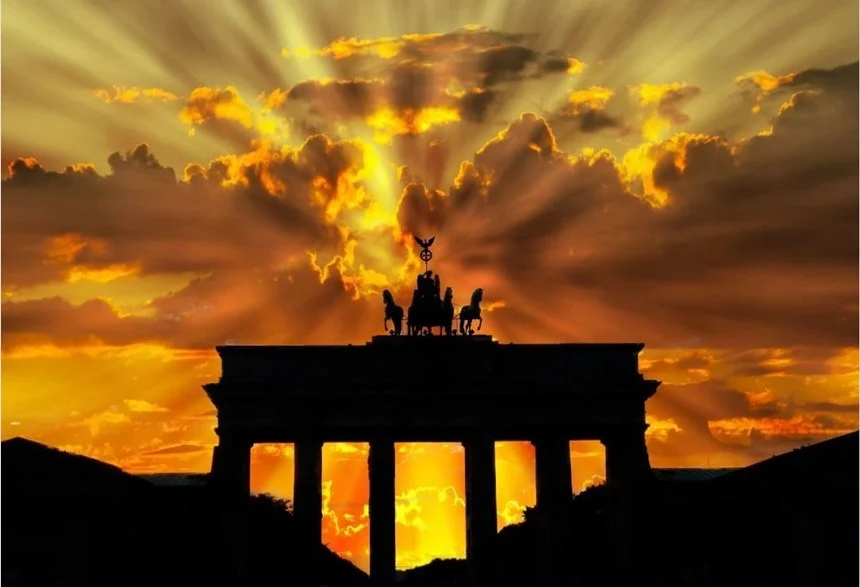
Berlin, which had slow economic growth due to the division of the city, has now become the city with the most startups in Germany and the youngest city in the world. Photo = City of Berlin
When did Berlin, once a “city of poor artists,” become a “mecca for startups”?
Berlin was one of the largest and most developed cities in Europe around 1870. Especially in the 1900s, most famous banks had their headquarters in Berlin, making it no exaggeration to say that Berlin led European finance. However, after World War II ended in 1945 and Germany was divided into East and West, West Berlin became an isolated island surrounded by East Germany. Major companies all left Berlin for West Germany, and until the Wall fell in 1989, Berlin was reduced to a poor city struggling economically.
After Berlin became the capital of a unified Germany, efforts to rebuild industry began anew. Industries in service, technology, and creative sectors, which can grow rapidly even without a pre-existing foundation, settled in Berlin. As large corporations in various fields such as Siemens, Deutsche Bank, Lufthansa, and Allianz established second headquarters, Berlin slowly regained its economic vitality. Of course, it was not yet competitive with the financial hub of Frankfurt, the research and development-centered technology industry led by North Rhine-Westphalia based on prestigious technical universities, or Bavaria, which has an economy strong enough to stand alone as a nation. However, as it emerged as the center of politics after unification, Berlin became an increasingly important city.
Young People Flocking Due to Low Living Costs and Techno Music
Meanwhile, artists began to gather because the cost of living was lower than in other German cities. While Hamburg was dominated by rock music and Düsseldorf by electro-pop, techno music was undoubtedly supreme in Berlin. Even during the division, art existed in Berlin. The popularity of Berlin techno music, which began in the 1960s, was led by young men from West Germany who wanted to avoid military service. Musicians who gathered in dark clubs to play experimental music and enjoy improvisation developed this into a resistant cultural movement centered around the Kreuzberg district of Berlin.
In the 1990s, Berlin’s unique techno music led the subculture centered around a few clubs. Young people who entered on Friday night and stayed up until Monday morning flocked to Berlin’s clubs, and soon Berlin attracted millions of tourists from all over the world. As the perception of “Berlin = a good place to play” grew, the young population increased rapidly. Currently, 55% of Berlin’s population is under 45, making it a young city with an average age of 42.7. At the same time, it has emerged as an international city where young people from all over the world gather. People from 190 countries now live in Berlin, and 21% of the total city population is of foreign origin.
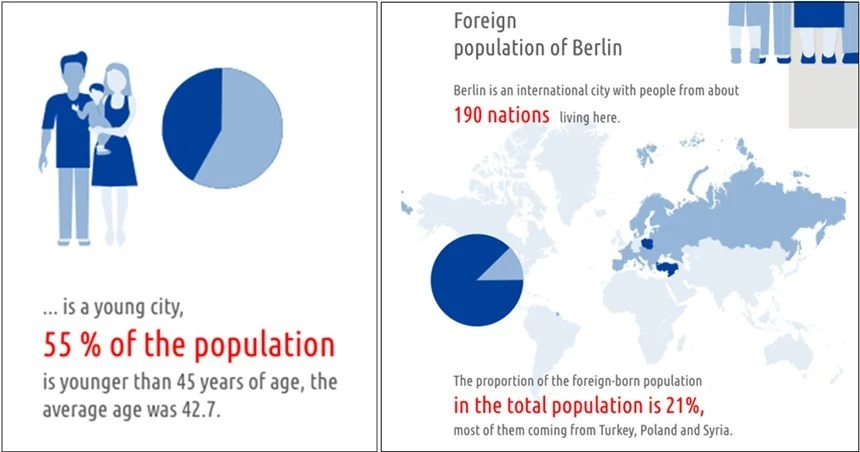
Source = City of Berlin (berlin.de)
Berlin’s Image Transformation
Berlin realized that trying to take the lead in automotive, finance, and bio/health sectors, where other cities were already focused, was meaningless. Instead, the city set its policy direction to attract and actively support startups by highlighting this young and international atmosphere. This coincided well with the global startup boom. Factory Berlin, established in 2014 in cooperation with Google, played a major role in attracting startups to Berlin. Many founders with ideas but little money gathered in Berlin, and Berlin Partner (Berlin Partner für Wirtschaft und Technologie GmbH), an economic promotion agency under the City of Berlin, also took the lead in actively attracting startups by establishing business support programs focused on them. In this way, Berlin became the city with the highest number of startups in Germany.
Berlin has an average of 40,000 business registrations per year, of which 500 are startups. Now, the title of “city of founders, artists, and an international and young city” fits better than the title of “poor but sexy city.” 80% of Berlin’s GDP comes from industries such as creative/cultural industries, tourism, media/information and communication technology, and transportation systems. Afterward, in 2017, Berlin was selected as the Internet of Things (IoT) and Fintech hub in Germany, becoming the city with the most IoT and Fintech startups in the country. That is, 295 Fintech startups, equivalent to 1/3 of all Fintech companies in Germany, are in Berlin.
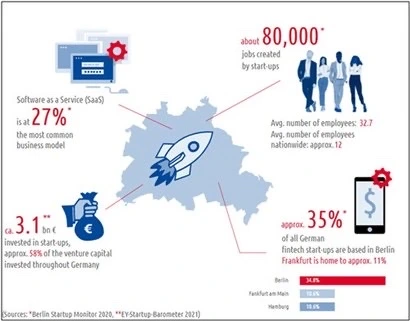
Source = Berlin Startup Monitor 2020
Berlin Grows into an International and Young City of Ideas
Since Brexit, many European headquarters of global financial institutions have moved to Frankfurt, which still holds the title of a traditional financial city, but most new ideas start in Berlin. N26, a unicorn that has now expanded not only to Germany but also to the US and surprised the global financial market, started in Berlin. Vivid, which conquered the Russian financial world and entered Europe; Penta, which makes it easy to open corporate accounts and manage them by linking with programs such as tax and accounting; and Trade Republic, an app for easy stock investment, are all from Berlin.
As startups have become more important, many large German corporations are also looking to Berlin for innovation. It has even become a trend for large corporations to establish their own startup accelerating institutions in Berlin. Bayer’s Grants4Apps is looking for startups in the bio/health sector, and telecommunications company Deutsche Telekom runs a co-working space called Hubraum to interact with companies that will become the main players of future growth. In addition, Axel Springer, Germany’s largest media company, operates the Axel Springer Plug and Play accelerating program in cooperation with Silicon Valley.
Life as a foreigner in Germany is not easy. Especially for someone who has experienced fast “services” like administrative services and delivery services in Korea, there are more than a few things that make one wonder “how such a country is still a developed nation” when first settling down. Germany also evaluates itself as lagging behind in “digitalization” and lacking innovation. In that sense, for Korean founders in particular, Germany is a land of possibility where the touch of improvement and innovation is needed everywhere.
Eunseo Yi eunseo.yi@123factory.de
This article was edited and adapted from the “European Startup Chronicles” series in BizHankook.