Meeting Three Korean Developers in Berlin ③
Cover photo source = fotolia.com
Finding a job abroad, developers’ work, and their future vision
What is it like to work as a Korean developer in Europe? We met three Korean developers who are active in the fintech sector in Berlin, Germany, to hear their stories. The protagonists are Gwangtaek An, a Senior Data Engineer at European insurtech leader Element Insurance AG; Junseok Oh, a Payment Engineer at Delivery Hero SE (which acquired Korea’s Baedal Minjok); and Sujin Lee, a Junior Developer at tax filing mobile app Taxfix GmbH.
※ Continued from [European Startup Chronicles] Meeting Three Korean Developers in Berlin ②.

Photo = fotolia.com
Startups in Berlin are not German companies. Most of them have a global atmosphere, so the vibe depends on which cultural group has the largest presence. In addition, for developers, skill takes precedence over age or career length.
#Recruitment and Organizational Culture in Europe
- All of you landed jobs abroad smoothly and are working stably as developers in Berlin. Were there any companies you applied to and got rejected by?
Junseok Oh (Oh): Many. I got rejected by travel platform Kayak. Although I’m glad I ended up at Delivery Hero because of COVID-19… I also got rejected by Klarna, a payment service provider. Klarna’s hiring process was truly incredible. It had 9 stages, almost on par with Google. Klarna is notorious in the industry for having a tough hiring process. I also heard that they have a heavy workload, though they offer great pay and welfare benefits. Lots of vacation days too. Depending on one’s values, it could be a better fit for some.
However, there is a company that left a positive impression even though I was rejected. It was a company installing EV chargers on lampposts to build grids. While delivering the rejection notice, they gave me extremely detailed feedback on the assignment I submitted. It felt like receiving corrections from a professor. It was a very good experience. There was a lot to learn even from the process of applying and failing.
Sujin Lee (Lee): I had a similar experience. I applied to a famous startup in Berlin and got rejected. They gave me an assignment they said would take about a day, but I spent a whole week preparing and submitting it. They gave me a task that required implementing a feature actually needed in their service and solving a problem their team was currently facing. Regrettably, I didn’t pass, but they gave me very detailed feedback. They asked why I chose that specific way to solve the assignment. Although I was rejected because I wasn’t a fit for them, I learned a great deal through this process. It’s something I hadn’t experienced in Korea.
Gwangtaek An (An): I also have experience being rejected by about four companies. One was Wayfair, a US-based furniture company, which has a European branch in Berlin. They also have a 7-stage hiring process. I reached the 6th stage, but I didn’t feel their recruitment process was very efficient. After interviewing with the Berlin branch staff, I interviewed with the US headquarters staff, and they asked the exact same questions. The technical interview wasn’t very difficult. However, in the final salary negotiation phase, there were areas where the company culture or style didn’t fit. They asked persistent questions about team culture and overtime, and it seemed they didn’t quite like my answers. Being a US company, the atmosphere seemed to take overtime for granted—attending meetings in line with US time zones when necessary, as if it were natural.
Another place was a German platform selling car parts, and there, German was the obstacle. They used English throughout the process, but at the end, they asked me to state my motivation for applying in German, which was when I wasn’t very good at German. I barely managed a self-introduction, and I was rejected. There were about two other places, but I don’t remember them well.
- Do developers perform their duties mostly in English?
Lee: In our company, only 1 out of 100 engineers is German.
An: There are no Germans in our team either. So we usually use English.
Oh: It’s the same for us. Since we have branches in global locations, English is effectively the official language.
- Incredible. What is the reason? Are Germans not good at development?
Lee: I was curious too, so I asked around. I heard that German developers often go to the US or the UK. Historically, Germany is a manufacturing-centered country with strong industries in finance and other sectors, so there wasn’t much demand for IT. I heard it has been changing lately, but it’s still lacking.
Oh: Here too, software engineers have an ‘American Dream.’ They think that if they are good, they should go to Silicon Valley.
An: At our company, there was a colleague who did an internship as a developer, then did another internship at Microsoft in the US, and they said it was a very special experience.
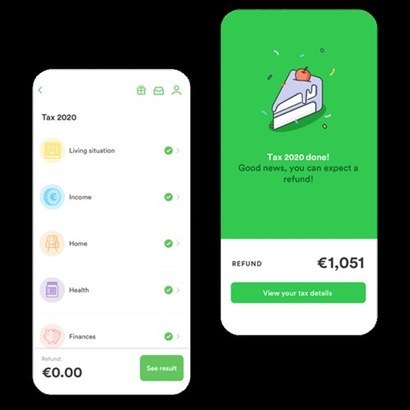
Product of Taxfix, a tax filing mobile app startup in Berlin. Photo = taxfix.de
- I heard that work-life balance is crucial in Germany, whereas in the US, people work more, have more overtime, and firing is easier. What is it really like?
Lee: In our company, we spent hours debating when deciding on the on-call (duty work) policy. All developers participated in the discussion, debating whether it complied with German law and how the allowance should be calculated. That’s how seriously the culture takes work-life balance.
An: I think it varies by company. In Berlin, most companies have a global atmosphere, so the vibe depends on which cultural group has the largest presence. For example, friends from Brazil and Portugal are similar to Koreans. They work a lot of overtime and even ask development questions via WhatsApp after 10 PM. However, managers do not hand down work orders at that time. It’s usually juniors asking development questions, and in those cases, I reply because I want to help. Looking at this, it doesn’t feel like a traditional German company culture.
Oh: That is definitely true. Companies with many German employees tend to preserve work-life balance, while companies with people from various countries have different management styles. Among ourselves, we say ’this is not a German-style German company.’ There is a lot of work. However, in most cases, you work overtime because planned tasks are delayed, or it’s limited to cases that could be critical to the company. For example, since the service my team provides is sensitive, there are times when massive losses occur if we don’t resolve issues quickly. But that’s very rare. Working on weekends or at night is usually because the initial schedule was delayed, and the delay is often due to handling other urgent matters.
In my case, I told the company I couldn’t do on-call duty. The atmosphere allows you to say such things naturally. The on-call person has to wake up at dawn if a service failure occurs. Since we need to communicate with card gateway companies to process payments, the service can sometimes freeze. Then, the engineer has to wake up and perform troubleshooting.
- In those cases, is there any separate incentive?
Oh: On-call duty is rotated only among those who want it. There is also an allowance. During the duty period, a standby allowance accumulates even if no failure occurs, and if a failure actually happens and you wake up at dawn to work, you receive a working allowance. I haven’t done it myself, but I once helped a colleague doing on-call duty on a day I worked late. Doing on-call duty means you can’t go anywhere and must only look at your computer. It rotates weekly, and you have to stay at home with your laptop open. So, family members often dislike it. If a couple is sleeping in the same bed and the alarm rings loudly, everyone wakes up. I’ve seen many cases where colleagues didn’t take on-call duty because their spouses disliked it.
Of course, there are advantages. Because you have to handle tasks alone while everyone is asleep, you need to know a lot to resolve failures even if they occur outside your domain. Some people find that rewarding. To handle on-call duty, you need to have excellent skills and capabilities. Those who do on-call duty end up developing that way. Consequently, they have more to say within the company. They get to know things well even if they are not their team’s responsibilities, gaining manager-like capabilities. There is a colleague in our team who turned thirty. He is very smart and works well, but because he did on-call, handled various tasks, and communicated with many people, he learned a lot about how the company runs and has already become a senior engineer. That is extremely fast for his age.

Delivery Hero, a food delivery app startup in Berlin. Photo = deliveryhero.com
- In the developer group, is age not very important? If so, what is important? Career length?
An: Career length is important. Age is not important when entering the company, nor is it important afterward. Sometimes, if we become really close, we might ask individually. But colleagues rarely know each other’s age.
Oh: Actually, career length is only important during interviews; once you enter the company, it’s not important. When you start working, your ability becomes visible immediately.
- In Korean companies, is age important for working as a developer?
Lee: Very important.
Oh: When I was in Korea, we posted a job opening because we needed a team member, and a person in their 40s applied. Their ability seemed good and their portfolio matched what we wanted, but many people gave feedback that it might be difficult to work together because of their age. So we rejected them.
An: Here, it is safe to say they rarely look at a developer’s age in the hiring process.
- Then, what is important for landing a job as a startup developer?
Oh: Age is not important. If you have a clear direction to work as an engineer, a willingness to learn, and secure time to invest, your career progression will be extremely fast. This part is different from Korea. When I was in Korea, I had a vague belief about learning while working or about career length. However, in this field, your ability improves as much as you effort to learn. Because technology trends are so fast, a rookie who learns new technologies well can be superior to a veteran who has done one thing for a long time. It wasn’t that I didn’t know this, and I had met outstanding people with short careers in Korea, but it was only after coming here that I could be certain. Having a clear vision and learning continuously is important.
Lee: In particular, they seem to look at cultural aspects a lot. They consider it important whether the company’s culture and the person’s style fit well. Berlin companies place great importance on diversity. The atmosphere is shifting from using he/him as a default pronoun for a general person to using they/them. Our company created and distributed a diversity booklet itself and established genderless restrooms. As a multinational and multicultural company, a culture of embracing and recognizing diversity is bound to be crucial.
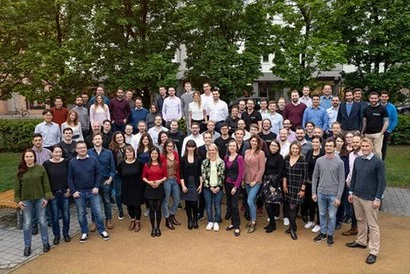
Members of Element, a Berlin-based insurtech startup. Photo = element.in
#Goals as a Developer and “After Berlin”
- Working in a Berlin startup, how do you want to grow as a developer? Is Berlin your final destination?
Oh: The biggest reason I wanted to come to Berlin was English. Because I realized that too much knowledge in the world is written or spoken in English, I thought I had to go to a place where they work in English to see bigger things. I chose this place as a middle ground. Although English is not yet as comfortable as my mother tongue, I want to place a lot of value on the fact that I have crossed the boundaries of the Korean language and Korea itself. In about 5 years, I want to develop my language ability, personal ability, and software engineering ability to communicate in professional developer groups.
An: I have two goals. One is to become a guru on the engineering side. I started with software engineering, went through data engineering, and now do a lot of work as a data scientist. At least in the data field, I want to become a guru-like engineer. The other is to found a startup. It’s not materialized yet, but I’m contemplating and studying with like-minded people around me.
Lee: I want to focus on building a good career. I think working abroad fits me better than Korea. Since I want to experience open source a lot, Berlin has many advantages. And when I came to Europe, I thought there would be many female engineers, but it seems there are even fewer than in Korea. I don’t feel any discrimination at all, but because of the lack of female engineers, I feel a sense of responsibility to some extent. So I want to focus on building my career for about 5 years, and later, I have the ambition to become a senior, manager, or tech lead as a female engineer. Our company’s CTO loved developing so much that he recently stepped down from the CTO position to become a coder like us. He sent a cool email to all employees saying, ‘I’m stepping down to focus on what I love.’ In this kind of freedom, I want to focus on what I love.
An: It reminds me of James Gosling, who created the Java language. Even in his 60s, he still works as a distinguished engineer at Amazon. He is someone who has his own know-how to do what he loves for a lifetime. He has a sort of geek disposition, which many developers admire. It’s like simply loving something.
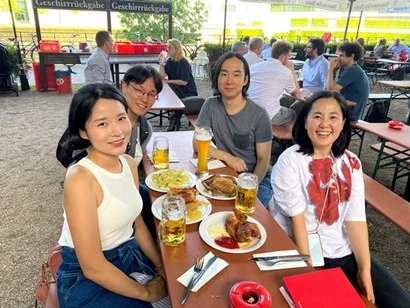
From left, developers Sujin Lee, Gwangtaek An, Junseok Oh, and the author. We look forward to the future these passionate individuals will draw. Photo = Eunseo Yi
As the startup boom occurred, the developer position also received a corresponding amount of attention. It is similar in Korea or Germany. The three developers who have already established themselves stably and are active in Berlin share commonalities despite having different careers and backgrounds. All of them are intensely immersed in their work. They didn’t leave Korea with a vague illusion or longing about working abroad or in startups, but hold concrete hopes and delicate passion for their work. And they are contemplating sharply to find their own paths. It is probably thanks to this rigorous accumulation of time that they can shine even in a global environment. We look forward to the future of these individuals, each passionate enough to be called a startup of their own.
Eunseo Yi eunseo.yi@123factory.de
This article was edited and adapted from the “European Startup Chronicles” series in BizHankook.